
There is one sentence in the National Protective Security Authority’s guidance on marauding terrorist attacks that should shape every decision a responsible person makes about their site:
Most deaths occur within the first few minutes of the attack, before police are able to respond.
Read that again, because it reframes the whole problem. The question is not “how fast will the police get here?” It is “what happens in the minutes before they do?” And the honest answer, for most premises, is: whatever your staff, your doors and your procedures can manage on their own.
This is an uncomfortable thought, but it is a workable one. NPSA and NaCTSO have published ten pieces of guidance on exactly this, built on analysis of previous attacks in the UK and abroad, live simulations involving hundreds of people, and direct feedback from businesses about where their plans fell over. None of it requires you to become a counter-terrorism expert. Most of it is about doing ordinary things well, and doing them fast.
This article walks through the five layers that make up a credible response — communication, lockdown, physical barriers, surveillance, and active delay — and where each one genuinely helps.
What a marauding terrorist attack actually is
A marauding terrorist attack, usually shortened to MTA, is a fast-moving, violent incident where assailants move through a location trying to find and kill or injure as many people as possible. It is a mobile attack, not a static one, and that mobility is the defining feature.
NPSA notes that MTAs take many forms and can combine several of the following:
- A lone attacker, multiple attackers, or multiple groups acting together
- Arrival on foot, by vehicle, or an attack carried out by an insider
- Entry without force, or forced entry using an explosive device, a vehicle, the coercion of someone with access, or a combination
- Attackers armed with bladed weapons, firearms, pipe bombs, petrol bombs, suicide vests, or several of these
One detail is worth holding onto when you think about delay. Bladed weapon attacks progress less rapidly than those involving firearms, because the attacker has to be within striking distance of each person and expends far more energy on each one. Where an attack is slower, every obstacle you put in its way is worth proportionally more. Seconds compound.
The guidance was written primarily for office buildings, including multiple-tenancy buildings, but NPSA is explicit that the principles apply across cinemas, hotels, hospitals, schools, shopping areas, shopping centres, stadiums, theatres, temporary event venues and transport hubs. If the public can get into your building, this applies to you.
This is preparedness, not compliance
A quick note before the five layers, because the two keep getting conflated.
Martyn’s Law — the Terrorism (Protection of Premises) Act 2025 — received Royal Assent on 3 April 2025. The implementation period is expected to be at least 24 months from that date, so the duties will not bite before spring 2027 at the earliest. We have written separately about what you can actually do right now, and about where security fog honestly sits in that picture.
It is worth quoting ProtectUK directly here, because it is the clearest statement on the subject and it is not one most suppliers will put in front of you:
Premises and events do not need to spend money on consultants to be compliant with the legislative requirements… neither the Home Office nor the SIA endorses any third-party products offered by the private sector.
That includes ours. MTA preparedness is the broader, older discipline that Martyn’s Law formalises parts of. You can be fully in scope of the Act and still have a weak MTA response. You can also be well outside it and still want your staff to know what to do. The guidance below is useful either way, and none of it is a compliance shortcut.
Run Hide Tell, which most people have heard of, is the advice aimed at the public. The MTA guidance is the organisational counterpart: it helps you build a security plan around those same principles so that your staff are not improvising.
Layer 1: Communication you can actually rely on
Every other layer depends on this one. If your team cannot tell each other where the attacker is, lockdown becomes guesswork and people walk into danger.
Mobile phones are not the answer. Networks congest during incidents, calls take too long, and one-to-one calling is the wrong shape for a situation where ten people need the same information at once. A radio system may be the right fit for your site.
But the radio has to be the right radio. There is a pattern emerging across the sector right now, particularly in education: organisations buying cheap, unlicensed consumer radios off the shelf ahead of Martyn’s Law, ticking a box, and assuming they are covered. They are not. Unencrypted consumer radios broadcast in clear on shared channels. During an incident, that means your lockdown status, your casualty locations and the positions of your staff are all audible to anyone with a matching handset — including, potentially, an attacker who brought one.
Licensed, encrypted radios cost more. They are also the difference between a communication system and a liability.
Whatever you use, the discipline matters as much as the hardware: a known channel, a known call sign for the control room, plain English rather than codes nobody remembers under stress, and announcements that tell people what is happening and where. NPSA’s supplementary guidance on announcements is worth reading on this — clear, consistent messaging throughout an incident keeps locked doors from being opened by someone who assumed it was over.
Layer 2: Lockdown you have actually practised
Lockdown is the single most effective procedural measure available to most sites, and the one most likely to fail on the day because nobody has rehearsed it.
NPSA sets out four types, and they are not interchangeable.
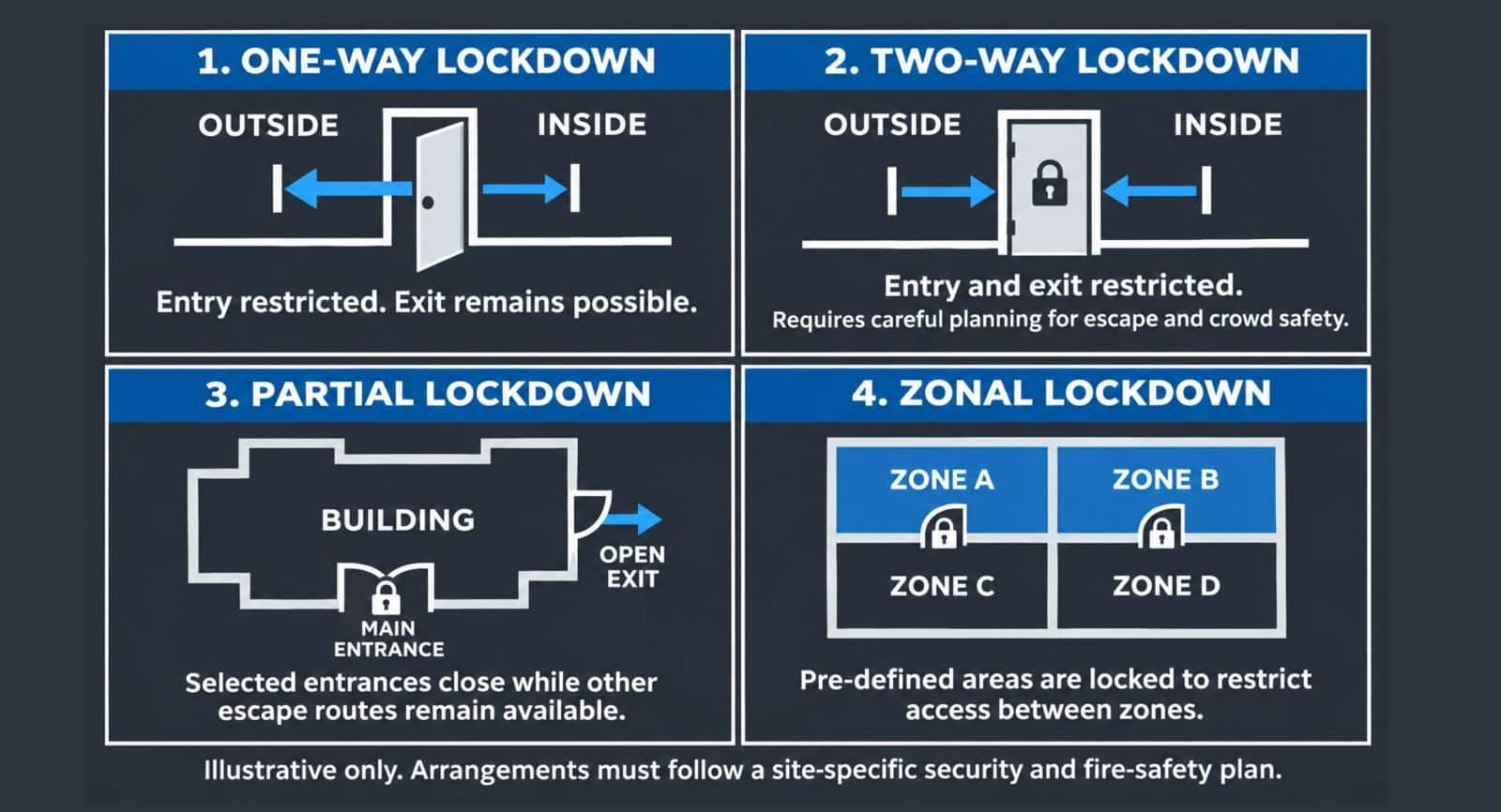
One-way lockdown. Doors lock on one side but open from the other. Attackers stay out; the people inside can still leave. It avoids the crush risk and it is often the strongest choice, provided the control room is communicating well enough that nobody props a door open behind them.
Two-way lockdown. Both sides locked — nobody in, nobody out. This needs very careful planning, because you are removing people’s ability to leave. If attackers reach the locked zone, the people inside cannot escape it. If a crowd flees toward an exit they cannot use, you have created a crush.
Partial lockdown. Close the main entrances to hold an attacker inside or outside specific areas, while leaving other routes available for people to escape.
Zonal lockdown. Lock pre-determined areas — individual floor plates in an office block, for example — so people can move to safer zones. NPSA’s warning here is blunt: a complex system of individually controlled zones is impractical to manage at the pace of a marauding attack. Keep it simple enough to actually operate.
On the mechanics, two things are worth doing now, cheaply:
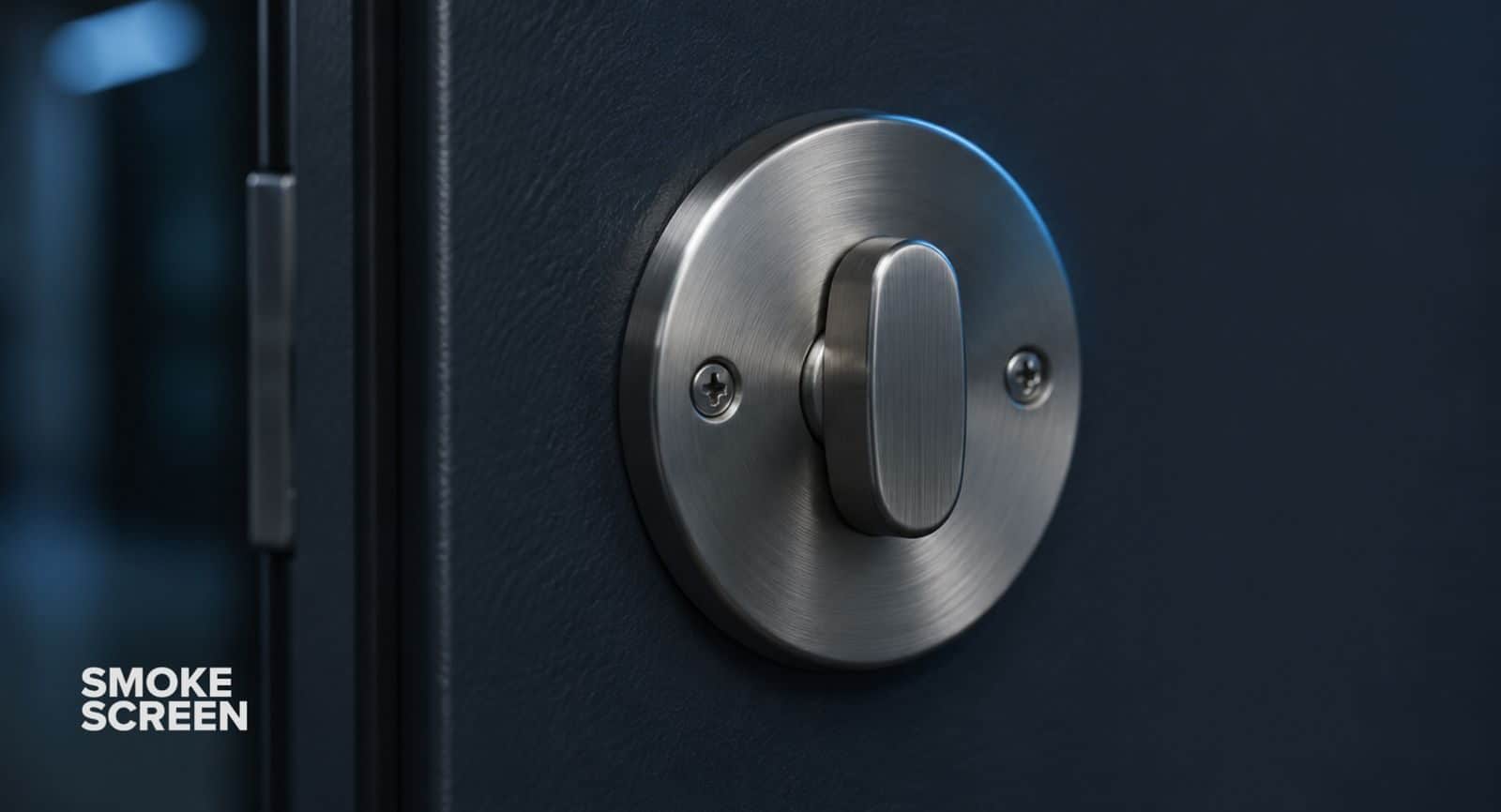
- Fit thumb turn locks. They are faster, need almost no training, and remove the dependency on a key that nobody can find.
- Put the lock where a frightened person can reach it. Mid-door, not at the top or bottom. Shutter and door controls should sit away from the door itself so they can be operated from somewhere safe.
And the rule that governs all of it: staff should never put themselves at risk to lock a door. Distance from the attacker comes first, always. Nobody moves toward an attack to secure a barrier.
Lifts and escalators should be locked down too where a central building management system allows it — but that is a control room task, not something to ask ground staff to run toward.
Layer 3: Physical barriers that buy measurable delay
As NPSA’s own lockdown guidance puts it, every barrier and every second counts. The useful thing about this layer is that the delay is measurable, and the UK has a standard for it.
The Marauding Terrorist Attack Standard (MTAS) classifies how long a physical barrier resists forced entry against three specific threats: bladed weapons used to attack the barrier itself; firearms followed immediately by forced entry with hand tools; and a small explosive device detonated in contact with the barrier, or a person-borne device nearby, again followed by forced entry.
Products are rated at sophistication levels of BASIC, LOW, MODERATE, HIGH and EXPERT, and those that achieve a classification are listed in NPSA’s Catalogue of Security Equipment across four chapters: doors, tubestiles and turnstiles; roller shutters; walls and enclosures; and window protection.
One trap worth knowing: locking hardware on its own cannot achieve MTAS. The hardware has to be assessed as part of a complete door set. A high-specification lock on an ordinary door does not give you a rated barrier, whatever the product sheet implies.
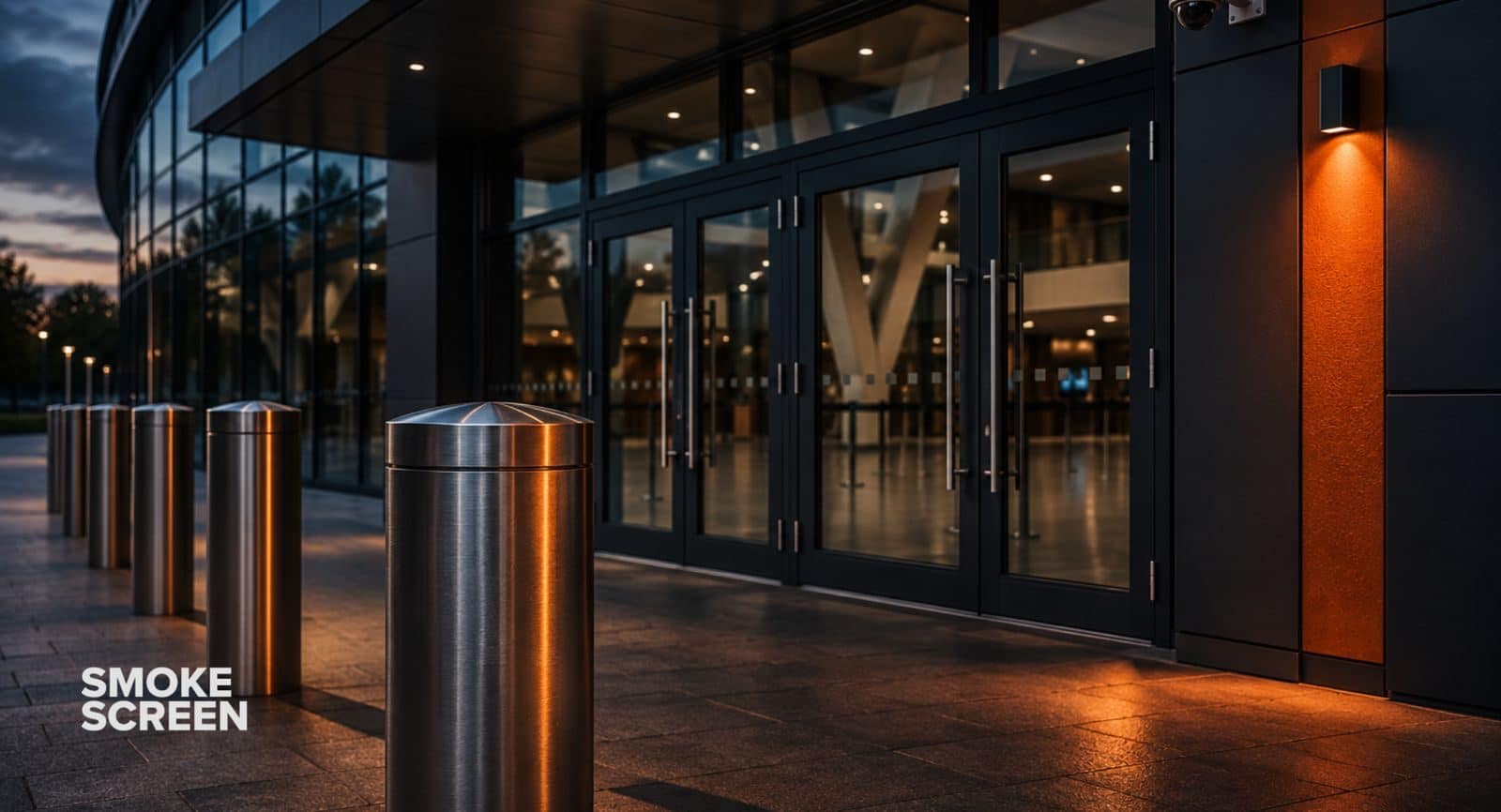
Outside the building, hostile vehicle mitigation — anti-terror bollards, planters, barriers at vehicle approach routes — addresses the arrival method rather than the attack itself. It is a different budget line and often a different supplier, but it belongs in the same risk assessment.
Layer 4: Lighting, CCTV and the control room
Cameras do not stop intrusion or intent. What they do is tell the people making decisions where the attacker is, which is what turns a generic lockdown into a targeted one.
Partial and zonal lockdowns in particular have to be monitored and reactive — the control room needs to track movement in real time and adjust. That requires camera coverage of approach routes, entrances and chokepoints, good lighting so the footage is usable at night, and a constant communication line between ground staff and the control room.
There is a detail here that catches people out. If you deploy active delay measures, your cameras have to be able to see through them. NPSA is specific: darkness may need infra-red illumination, and fog may require a thermal imaging camera working alongside a conventional one. Conventional cameras still matter — they confirm the measure activated, show the extent of deployment, and show the scene as the fog clears — but a control room that goes blind the moment it deploys fog has lost the situational awareness it needs to manage the incident.
It also requires operators trained for this specific scenario rather than for shoplifting. NPSA runs a dedicated course for security control room operators responding to terrorist incidents, aimed at national infrastructure sites and crowded places. If you have a staffed control room, that is a direct, practical investment.
The control room’s other job is the one people forget: feeding accurate information to the emergency services as they arrive, and keeping announcements going so that people inside know whether it is over.
Layer 5: Active delay — where security fog fits
This is the layer we know best. We have been building security fog systems for over thirty years.
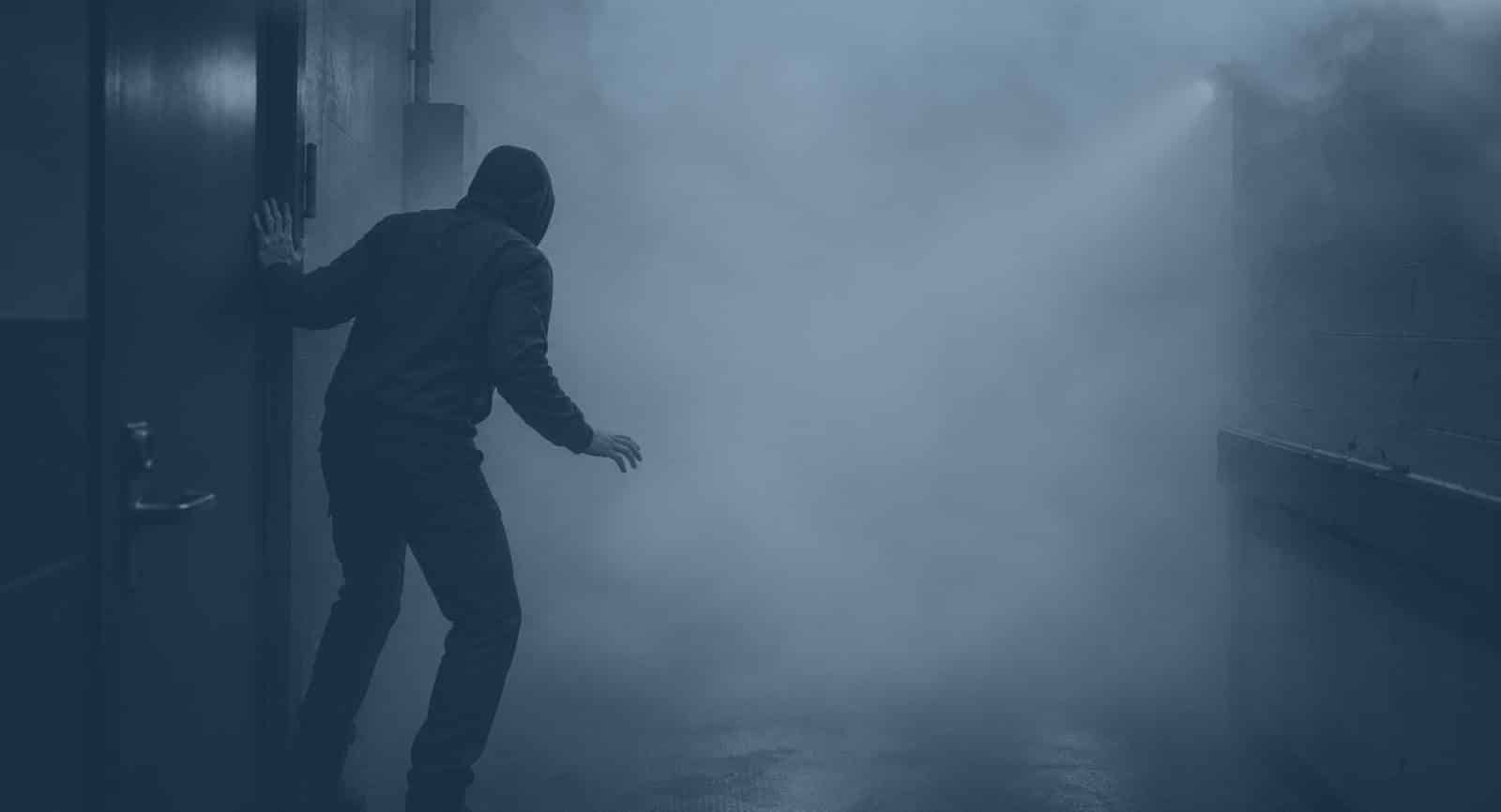
NPSA’s supplementary guidance on Active Delay Systems covers pre-positioned reactive systems designed to slow an adversary down. The guidance groups them into types, and one of those types is sensory — delay caused by creating confusion, uncertainty or discomfort, and so disrupting the attacker’s actions. The examples NPSA gives for that category are security fog, noise and flashing lights.
That matters, and it is worth being precise about why. It does not mean fog makes a site compliant with anything. It means security fog sits in the recognised-measures column rather than the marketing-claims column, as we set out in more detail here.
Two findings in that guidance are worth more than any claim we could make ourselves.
The first is about barriers. NPSA states that fog deployed in conjunction with a low-security barrier can dramatically improve the overall delay resistance of that measure — often doubling it or more. That is the single most useful thing in this article for anyone with an existing door they cannot afford to replace. Fog does not compete with Layer 3; it multiplies it.
The second is about combinations. NPSA’s trials found that the most effective sensory deployment pairs security fog with strobe lighting — highly disorientating, strong effects on balance and spatial awareness, virtually no visual clues. We make fog systems, not strobes. We are telling you this because it is what the evidence says.
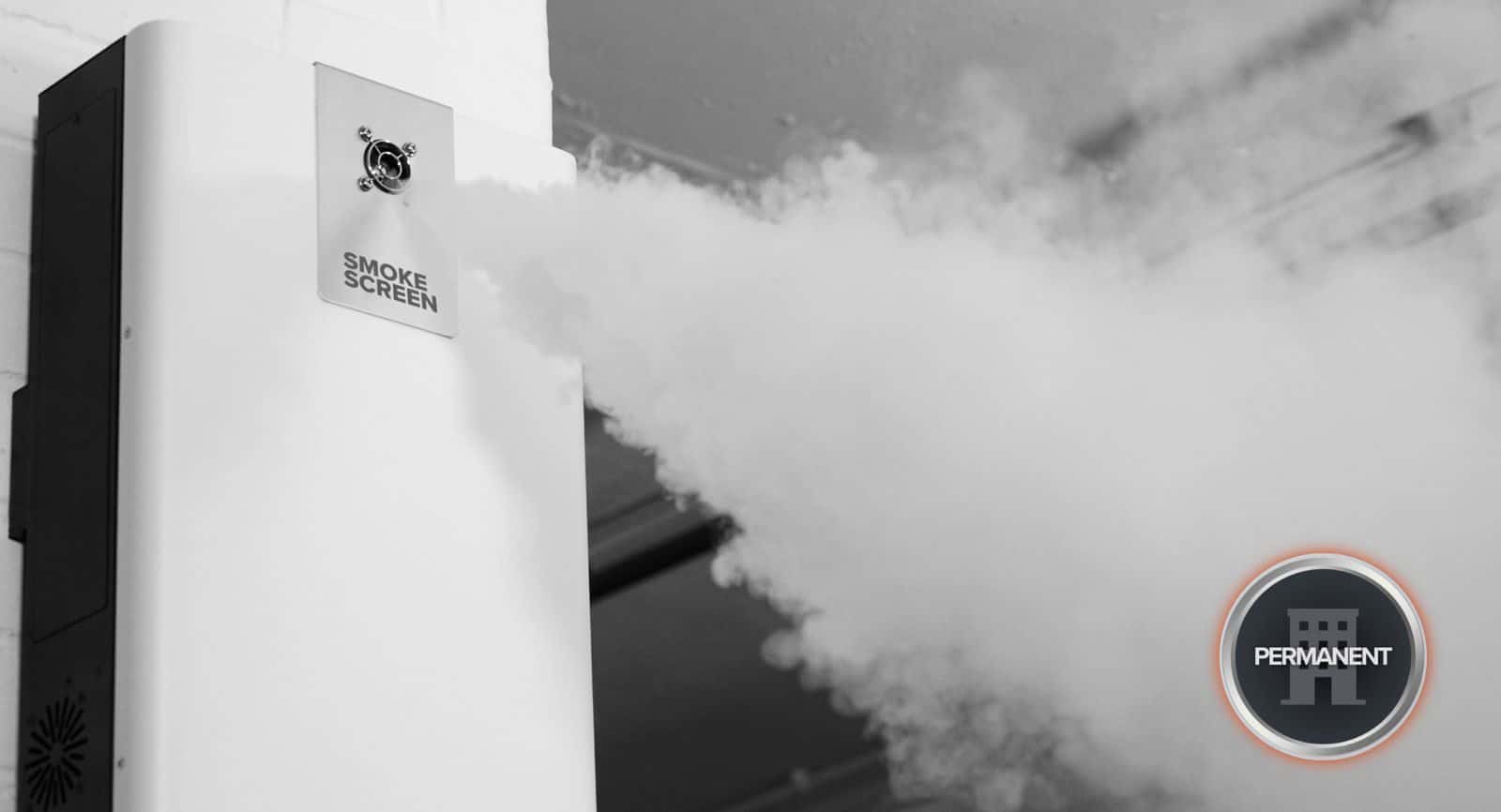
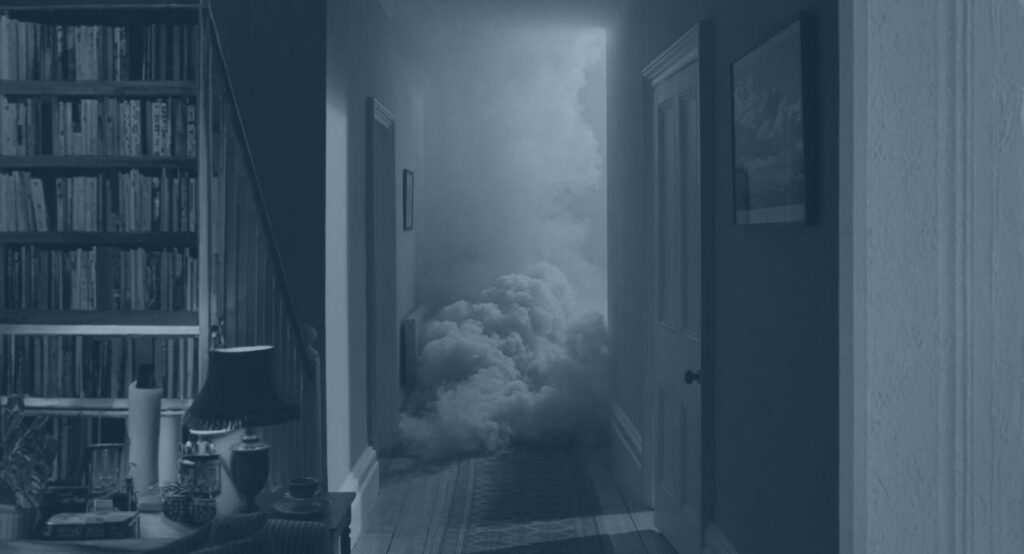
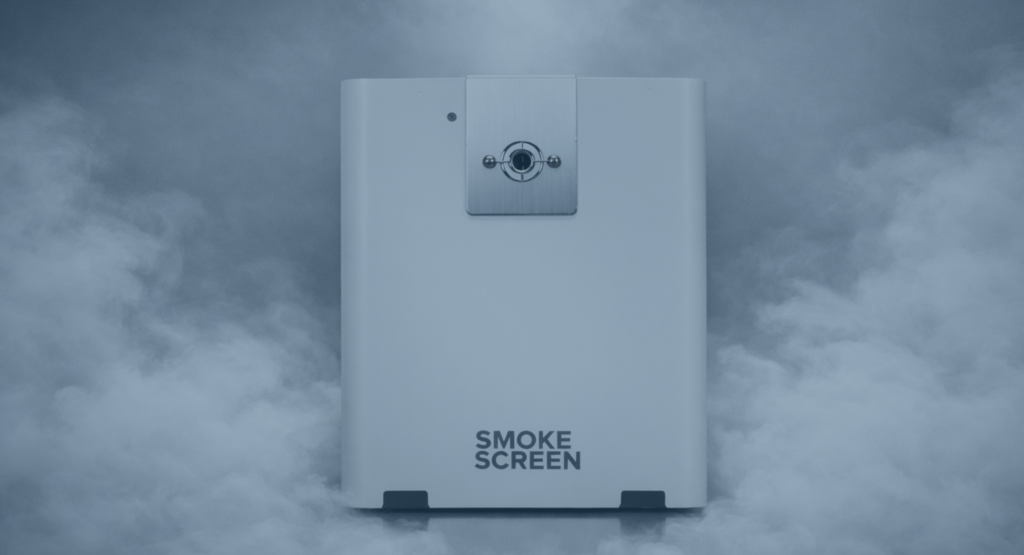
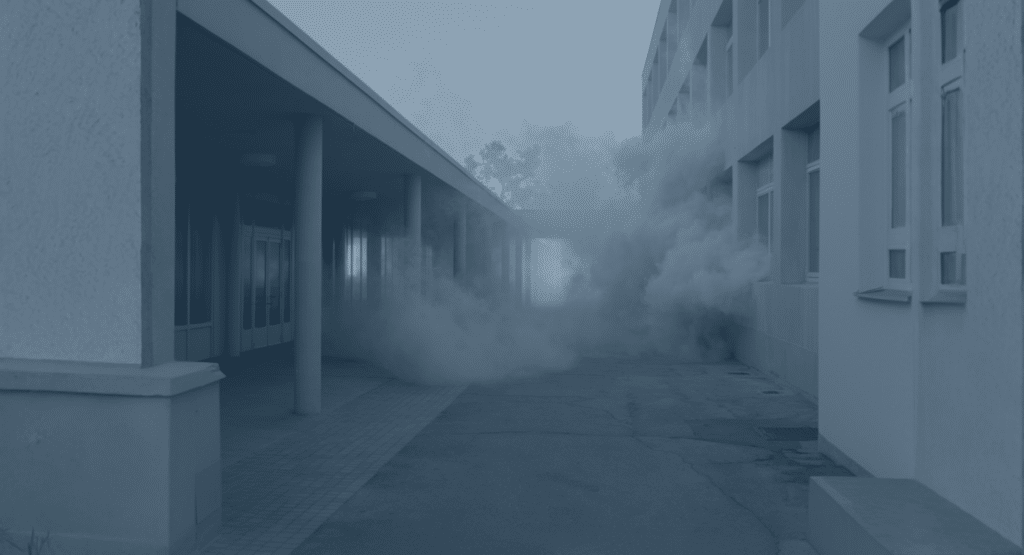
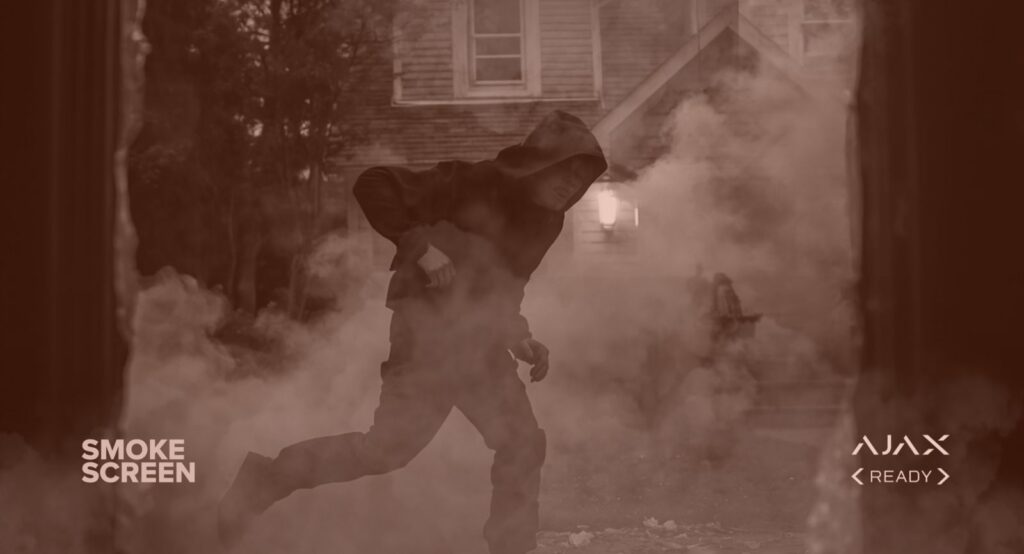
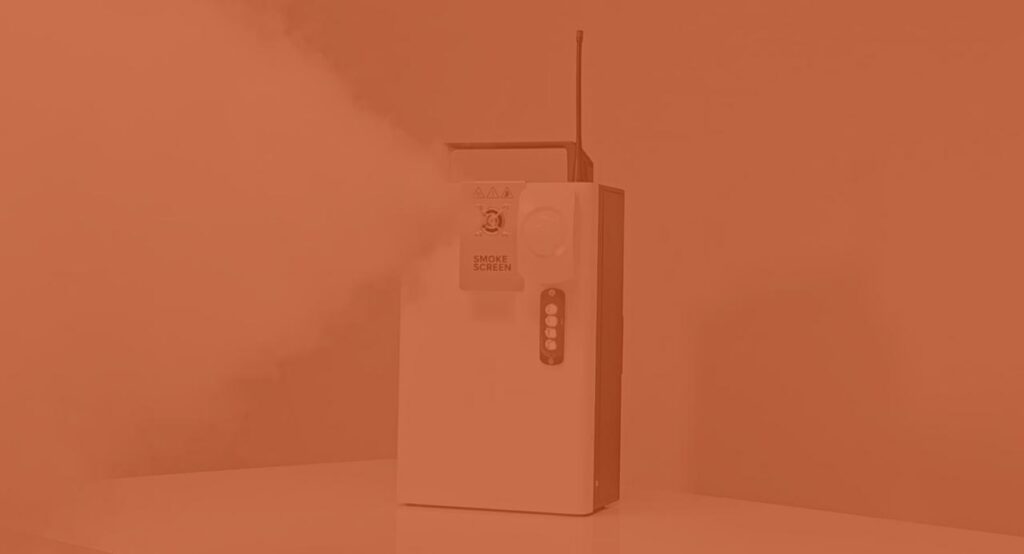
The mechanism itself is simple. A Sentinel fog generator fills a space with dense, harmless fog within seconds. An attacker who cannot see cannot move quickly, cannot navigate confidently, and cannot easily reach the area or the people they were heading for. Movement slows, access to a protected route is denied, and the attacker’s plan is disrupted at exactly the moment a coordinated response has its best chance.
Where fog belongs, and where it does not
The discipline — and this is the part that separates a serious measure from a gimmick — is that fog must be targeted, not blanket. NPSA is specific about placement:
- Main entry points, because that affects the early stage of an attack
- Internal corridors and other confined spaces, where density holds
- In conjunction with a security door or other barrier, for the doubling effect above
- Not on stairs. NPSA does not recommend it
- Not at every entrance. Some entry and exit points must be left uncovered so police have a route in and people have a route out
Fog also has to be designed around fire safety rather than beside it. Three points from the guidance that any competent installer should raise with you unprompted: security fog can activate smoke sensors, so heat detectors may be the better choice in protected areas; if a fire is confirmed, the system should be deactivated so people can escape; and fog disperses through gaps in doors, windows and HVAC, so leakage needs to be understood at commissioning. It also takes time to clear, which matters when armed officers need to move through the space.
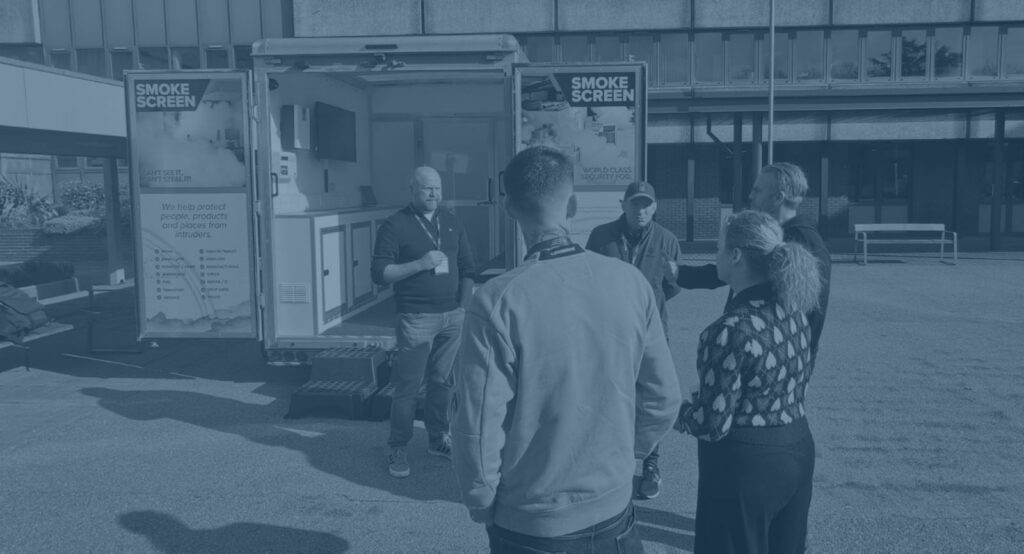
Because risk is not static, the capability comes in more than one form — permanent, deployable and monitored. Permanent systems protect known vulnerable areas. Deployable units cover temporary risk, events, or sites awaiting permanent works. And Sentience sits across both, because an active delay system only matters if it works on the day — which means knowing it is online, fault-free and ready, rather than assuming it.
Customised protection
NPSA is explicit that every site is different and that lockdown has to be designed around your access points, your barriers, your staffing and your layout. Two venues following the same guidance well will not end up with the same plan.
Security through obscurity means staff who do not know what to do, which is the condition the guidance exists to fix. The answer to predictability is not secrecy — it is designing, testing, exercising and refining your procedure until it fits your building, and keeping the specifics of your plan, your zones and your timings internal.
That is the balance: use the public principles, keep your particulars private.
Where to start
If you are at the beginning of this, four questions are worth more than any product conversation:
- What are you trying to stop happening?
- Where would it happen on your site?
- Who needs to be protected, and where would they be?
- What should happen in the first 60 seconds?
Answer those honestly and the five layers above sort themselves into priority order. For most sites the cheapest, highest-value moves come first — a rehearsed lockdown procedure, thumb turns on the right doors, radios that work, and staff who have had an hour of ACT awareness training. Active delay comes later, in the specific places your risk assessment points to.
What it should never be is the first purchase made in a hurry because a supplier put a deadline in front of you.
Talk to Smoke Screen
If you are working through your MTA preparedness and want to understand where active delay genuinely fits — and where it does not — we are happy to think it through with you, starting with the risk rather than the hardware.
- Book a security assessment
- Ask about active delay in your specific environment
- Speak to us about Sentience and estate-level readiness
Can’t see it, can’t steal it.
Frequently asked questions
What is a marauding terrorist attack?
A marauding terrorist attack (MTA) is a fast-moving, violent incident in which one or more assailants move through a location trying to find and kill or injure as many people as possible. NPSA notes that most deaths occur within the first few minutes, before police are able to respond.
What are examples of marauding terrorist attacks?
MTAs can involve a lone attacker or multiple groups, arriving on foot, by vehicle, or acting as an insider. Attackers may enter without force or force entry using a vehicle, an explosive device or the coercion of someone with access, and may be armed with bladed weapons, firearms, pipe bombs, petrol bombs or suicide vests.
How should an organisation respond to a marauding terrorist attack?
NPSA guidance centres on recognising an attack, taking immediate action and facilitating the police response. In practice that means reliable communication, a rehearsed lockdown procedure, physical barriers that delay forced entry, control room monitoring, and, where a risk assessment supports it, active delay systems at chokepoints.
What is the difference between MTA preparedness and Martyn’s Law?
Martyn’s Law, the Terrorism (Protection of Premises) Act 2025, received Royal Assent on 3 April 2025, with an implementation period expected to be at least 24 months from that date. MTA preparedness is the broader operational discipline. Being in scope of the Act does not automatically mean your MTA response is adequate, and no product makes a premises compliant.
What types of lockdown are there?
NPSA describes four: one-way lockdown (locked on one side, openable from the other), two-way lockdown (locked both ways), partial lockdown (main entrances closed while other routes stay open) and zonal lockdown (pre-determined areas locked). Each is managed either centrally through access control or manually.
Is security fog recognised in UK counter-terrorism guidance?
Yes. NPSA’s MTA supplementary guidance on Active Delay Systems lists security fog as an example of a sensory active delay system, one that delays by creating confusion, uncertainty or discomfort and so disrupting an attacker’s actions. This is recognition as a measure, not a compliance claim.
Where should security fog be deployed in a building?
NPSA identifies main entry points, internal corridors and other confined spaces, and deployment alongside a security door or barrier. It does not recommend fog on stairs, and it advises leaving some entry and exit points uncovered so emergency services have a route in and occupants have a route out.
What is the Marauding Terrorist Attack Standard (MTAS)?
MTAS determines the resistance time a physical barrier provides against bladed weapon attack, firearms followed by forced entry, or a small explosive device followed by forced entry. Products are classified at BASIC, LOW, MODERATE, HIGH or EXPERT levels and listed in NPSA’s Catalogue of Security Equipment. Locking hardware alone cannot achieve an MTAS rating, as it must be assessed as part of a complete door set.
Do we need licensed radios for lockdown communication?
Unencrypted consumer radios broadcast in clear on shared channels, which means lockdown status, staff positions and casualty information could be heard by anyone with a matching handset. Licensed, encrypted radios cost more but are the appropriate choice where the communication itself is security-sensitive.
What is Run Hide Tell?
Run Hide Tell is the public-facing campaign advising individuals what to do during an attack. The MTA guidance is its organisational counterpart, helping premises build a security plan based on the same principles so staff are not improvising.